You left the house with neat waves, and an hour later — a fluffy halo on your head. The ends are dry, the curl is falling apart, and brushing through the length without pain is impossible. Sound familiar? Curly hair gets frizzy not because it is “unruly,” but because it is structured differently from straight hair — and standard care often does not suit it.
The good news: caring for curly hair does not require ten products. It is based on two things — gentle cleansing of the scalp and proper conditioning of the length. Below — why this is so and how to do it.
Why wavy and curly hair is more often dry and frizzy
Sebum does not move well along the curl
Sebum — the natural “conditioning” of the hair. On straight hair, it easily spreads from the roots to the ends. On wavy and curly hair, every bend is an obstacle: the roots may be normal or even oily, while the middle of the length and the ends remain dry.
The cuticle is raised at the bends
Where the hair shaft curls, the cuticle scales lie unevenly. The surface becomes rougher, the hairs catch on each other — hence tangling and a feeling of dryness to the touch.
Curly hair is often porous
Porous hair quickly absorbs water and just as quickly gives it away. In humid weather, it draws moisture from the air, swells — and frizz, uncontrolled fluffiness, appears. High porosity can be natural, or it can be acquired: after bleaching, coloring, or regular use of a flat iron.
Why the glass-of-water test should not be considered a diagnosis and how to determine hair porosity more reliably — we covered separately. If you are not sure what your curl type is, start with “How to Determine Your Hair Type.”
The scalp is a separate story
When it comes to curls, attention is usually focused on the length. But the scalp has its own needs — and often it is the first to suffer.
What is the scalp microbiome
The scalp microbiome is a community of microorganisms that naturally live on its surface. When their balance is maintained, the skin feels comfortable: without tightness, itching, excessive oiliness, or flaking. The balance is easy to disrupt — both through overly aggressive cleansing and, conversely, insufficient cleansing.
The “wash less — better” trap
To avoid overdrying curls, many people wash their hair rarely or switch to washing only with conditioner (co-wash). The length may indeed like this. But the scalp accumulates sebum, product residue, and styling products — and over time, discomfort may appear.
The solution is not to give up shampoo, but to choose one that cleanses the scalp gently: without a feeling of tightness and without overdrying the length.
Shampoo for the scalp: what should be in the formula
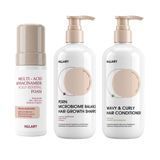
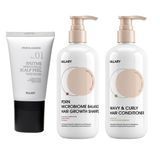
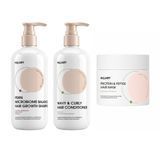
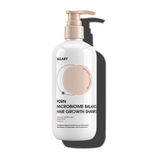
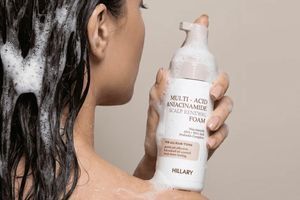
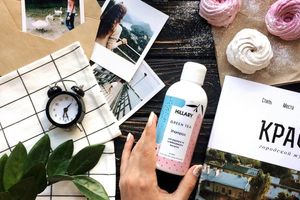
For wavy and curly hair, shampoos with mild cleansing ingredients and care specifically for the scalp are suitable. An example of such a formula is the HiLLARY Polynucleotide Shampoo, 400 ml:
|
Ingredient (INCI) |
What it does |
|
Mild surfactants (Sodium Cocoyl Glutamate, Coco-Glucoside, Cocamidopropyl Betaine) |
Cleanse sebum, impurities, and styling residue without a feeling of tightness |
|
Prebiotic complex (Inulin, Alpha-Glucan Oligosaccharide) |
Helps maintain the natural balance of the scalp microbiome |
|
Polynucleotides (Sodium DNA, PDRN) |
A caring ingredient that helps maintain skin hydration and comfort |
|
Panthenol (Panthenol) |
Moisturizes and soothes the scalp, reducing the feeling of dryness |
|
Saccharide Isomerate |
Helps retain moisture in the skin |
|
Vitamin E + sunflower seed oil (Tocopherol, Helianthus Annuus Seed Oil) |
Antioxidant and softening care |
|
Conditioning polymers (Guar Hydroxypropyltrimonium Chloride, Polyquaternium-7) |
Make combing easier after washing |
The shampoo contains no SLS or SLES, as well as no silicones. It is suitable for regular use and for all scalp types.
Conditioner for curly hair: what should be in the formula
Если шампунь отвечает за кожу головы, то кондиционер – за длину и завиток. Для пористых волос нужны липиды, которые смягчают, и кондиционирующие компоненты, которые разглаживают поверхность. Именно так построен липидный кондиционер HiLLARY для кудрявых, пористых и волнистых волос, 400 мл:
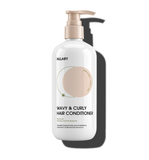
If shampoo is responsible for the scalp, then conditioner is responsible for the length and the curl. Porous hair needs lipids that soften it and conditioning ingredients that smooth the surface. This is exactly how the HiLLARY Lipid Conditioner for curly, porous, and wavy hair, 400 ml, is formulated:
|
Ingredient (INCI) |
What it does |
|
Shea butter (Butyrospermum Parkii Butter) |
Rich in lipids, softens dry and porous lengths, helps maintain their lipid layer |
|
Hydrolyzed Moringa seed extract (Hydrolyzed Moringa Oleifera Seed Extract) |
Improves conditioning, smoothness, and hair elasticity |
|
Conditioning complex (Cetrimonium Chloride, Behentrimonium Methosulfate) |
Makes detangling easier, reduces static electricity |
|
Polyquaternium-7 |
Additionally smooths the hair and helps control frizz |
|
Isoamyl Laurate |
A lightweight emollient — softness without weighing the hair down |
|
Isopentyldiol + Sorbitol |
Help maintain hydration of porous lengths |
The conditioner contains no silicones — waves and curls retain their natural movement, and the hair is not weighed down.
The result: the length is softer and smoother, easier to comb, frizz is less pronounced, and the curl is neater and more defined. 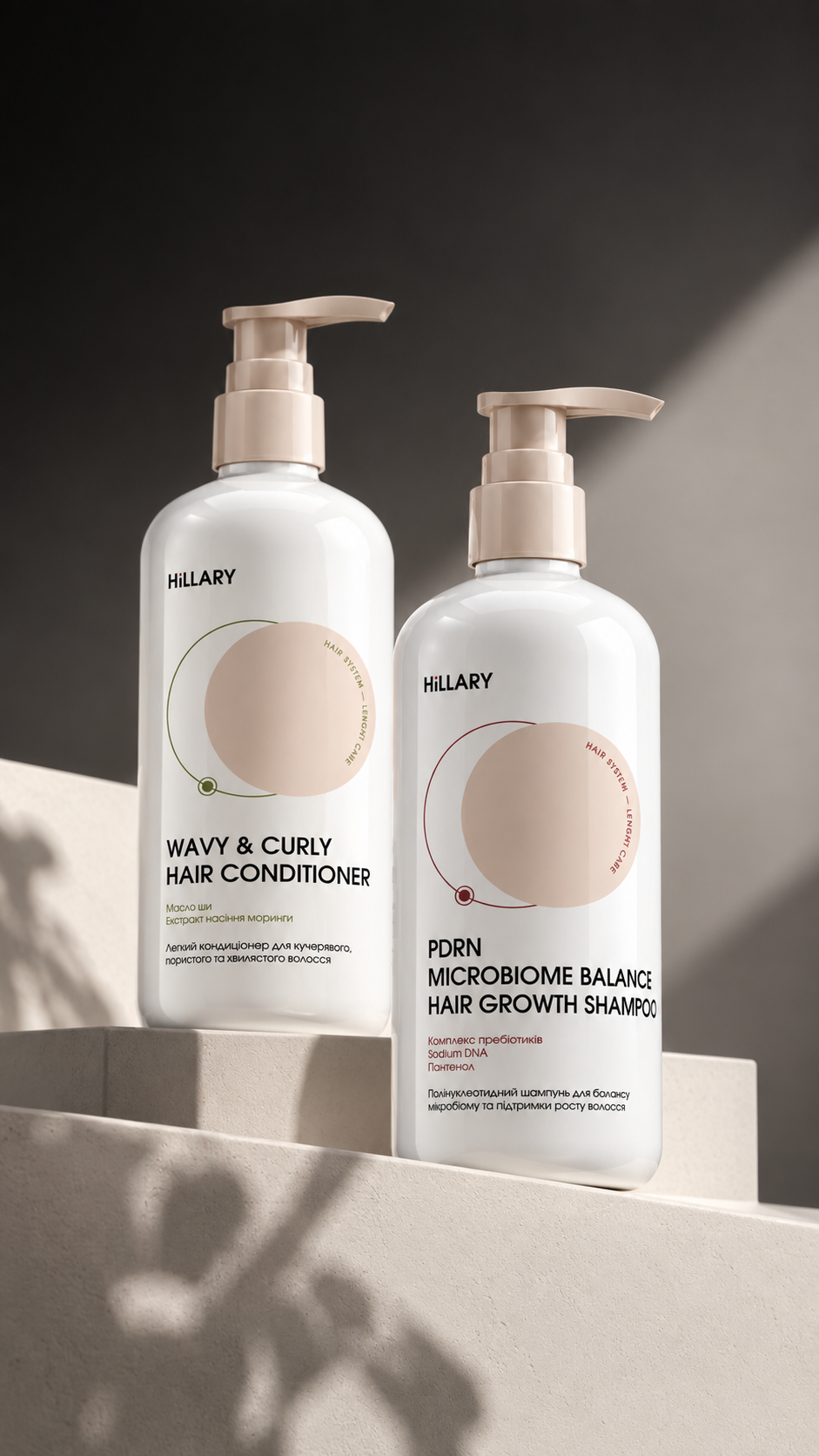
How to care for curly hair: step by step
- Wet your hair with warm, not hot, water
- Apply shampoo to the scalp — нa small amount — and gently massage with your fingertips until foam forms. Do not rub the length: the foam will cleanse it while rinsing
- Rinse thoroughly. Repeat if necessary
- Gently squeeze the water out of the hair with your hands and apply conditioner along the length, keeping away from the roots. Pay special attention to the driest areas and the ends
- Detangle with your fingers or a wide-tooth comb — while the conditioner is on the hair, the slip is best
- Leave for 2–5 minutes and rinse thoroughly
- Do not rub with a towel — squeeze the hair with a cotton T-shirt or microfiber towel, scrunching the strands from the bottom upward
If the length is very dry or bleached, you can add a pre-shampoo before washing — it is applied to the length and ends 5–10 minutes before shampooing. And for waves that lack texture, a salt spray can be used after drying — how it works was covered in a separate article.
Common mistakes in curly hair care
- You brush dry hair with a brush. The curl breaks apart into fluff, and the hair breaks. It is better to detangle curls while conditioning.
- You apply conditioner to the roots. The result is weighed-down hair and faster buildup. Conditioner is only for the length.
- You have completely given up shampoo. The length may like this, but the scalp needs regular cleansing. Choose a gentle shampoo rather than giving it up.
- You rinse out the conditioner immediately. The ingredients need several minutes to distribute across the surface of the hair shaft. Give it 2–5 minutes.
- You dry your hair with hot air without a nozzle. The airflow breaks up the curl and increases frizz. A diffuser at a moderate temperature or air-drying is better.
- You use only protein-based products. Excess protein without hydration makes curls stiff. A protein mask — once every one or two weeks, not every day.
How often to wash curly hair
There is no universal answer — focus on the scalp, not the length.
|
Your scalp |
How often to wash |
|
Dry or normal |
1–2 times a week |
|
Normal, hair becomes oily on day 3–4 |
2–3 times a week |
|
Oily |
Every 1–2 days — with a gentle shampoo and conditioner only on the length |
The more often you wash your hair, the more important it is that the shampoo is gentle and that the length receives conditioner after every wash.
Shampoo and conditioner together
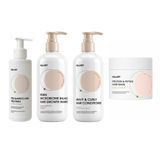
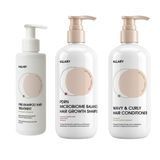
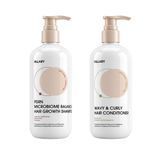
Shampoo and conditioner work as a pair: the first cares for the scalp, the second for the length and the curl. Both products are included in the HiLLARY set with a polynucleotide shampoo and lipid conditioner — a daily care system from the scalp to the ends.
If the length is weakened and brittle, it is worth adding a protein peptide mask once a week to the pair. All products from the line are in the “Scalp Microbiome and Damaged Hair Care” section.
When it is worth seeing a specialist
Dryness, frizz, and tangling are matters of hair care. But if dandruff, itching, flaking, redness of the scalp, or noticeable hair loss appears, it is worth seeing a dermatologist or trichologist. Cosmetic care does not replace diagnosis. Possible causes of hair loss are covered in the article “Hair Loss.”
Questions and answers
Why does curly hair get frizzy? Curly and wavy hair is often porous: it quickly loses moisture and draws it from the air, while the cuticle is raised at the bends. This causes dryness, tangling, and frizz. Gentle washing and a conditioner with lipids help.
Which shampoo should I choose for curly hair? A shampoo with mild cleansing ingredients — based on amino acids, glucosides, betaine — and care for the scalp: prebiotics, panthenol. It should cleanse the scalp without a feeling of tightness.
Can curly hair be washed with conditioner only? The length may tolerate this, but the scalp needs regular cleansing of sebum and product residue. It is better to combine a gentle shampoo for the scalp with a conditioner for the length.
How long should I leave conditioner on curly hair? 2–5 minutes on wet hair, along the length, keeping away from the roots. After that, rinse thoroughly.
Are products suitable for the Curly Girl Method? The HiLLARY Polynucleotide Shampoo contains no SLS, SLES, or silicones, while the Lipid Conditioner contains no silicones. If you follow specific rules of the method, check the full INCI list on the product page.
Is the Lipid Conditioner suitable for straight hair? Yes, if the hair is dry or porous — for example, after bleaching or coloring. For fine straight hair, start with a smaller amount so as not to weigh down the length.
How often should curly hair be washed? Focus on the scalp: dry — 1–2 times a week, oily — every 1–2 days with a gentle shampoo. Conditioner — after every wash.