You’re buying your third mask for damaged hair in six months, and none of them has delivered what it promised. A reasonable question is — why doesn’t a hair mask work if the packaging says it is designed specifically for your problem?
Because “dry hair” is not a single diagnosis, but three different conditions. Hair hydration, hair nourishment, and hair repair address different needs, and if you misidentify your condition, the mask won’t give you the result you expected.
Here’s how to tell them apart and check at home.
What is the difference between hair hydration and nourishment?
Hair hydration – it’s about water
The hair shaft has lost moisture: the cuticle is lifted, and water evaporates faster than it can be retained.
Signs: frizz, static, dullness, hair that “falls apart” in your hands and behaves worse in winter. It feels somewhat dry to the touch, but not stiff.
What works: humectants – glycerin, panthenol, sugar-based complexes.
Hair nourishment – it’s about lipids
There is a lack of fats: the natural lipid layer has been washed away by shampoos, stripped during coloring, or damaged by sun exposure.
Signs: stiffness, a “straw-like” texture, lack of shine, roughness when running your fingers from the ends toward the roots.
What works: oils, butters, fatty alcohols, emollients. If this is your case, start with a hair oil – it provides lipids in a purer form than a mask.
Hair structure repair: what does it actually mean?
Here, honesty is important because this is where the most marketing exaggeration happens.
The actual structure of the hair has been damaged: the cuticle is worn away, and protein bonds have been disrupted after bleaching, perming, or using straightening tools. Cosmetics do not build a new hair shaft and cannot “fuse” damaged hair back together. What they actually do is improve the mechanical properties of hair that has already grown: they increase elasticity, smooth the surface, and reduce breakage during brushing and styling.
So when the packaging says “hair repair,” it refers to the appearance and behavior of the hair, not regeneration. Understanding this limitation immediately eliminates half of the disappointment with hair care.
Signs that you need this category specifically: dry and brittle hair that breaks along the length; split ends that appear quickly after a haircut; wet hair that stretches and does not return to its original shape.
What works: hydrolyzed protein and peptides.
How to determine hair porosity at home
Porous hair – is a key concept that affects your entire hair-care routine. Porosity indicates how tightly the cuticle is closed.
The glass-of-water test: why you shouldn’t rely on it
You’ve probably seen the advice to place a strand of hair in a glass of water: if it floats, you have low porosity; if it sinks, you have high porosity.
This test is unreliable. The result depends more on the surface tension of the water, air bubbles, traces of sebum, and styling products than on porosity itself. The same strand can either float or sink depending on how you place it in the water. Use it as a clue, not as a diagnosis.
More reliable signs of high porosity
- hair absorbs water almost instantly and becomes heavy within seconds
- hair dries quickly without a blow dryer
- products seem to “disappear” immediately, and the effect doesn’t last long
- hair becomes very frizzy in humid weather
- after bleaching or perming, porosity is high by default – you don’t need a test at all
Hair elasticity test
Hair elasticity – is its ability to stretch and return to its original shape. This is the most informative at-home test. Take a wet strand of hair and slowly pull both ends:
- it stretches and returns – elasticity is fine
- it breaks immediately – the hair is fragile and lacks moisture and flexibility
- it stretches like rubber and doesn’t return – the protein structure is compromised; this is where proteins are needed
Why doesn’t a hair mask work? 7 real reasons
- You’re treating the wrong problem. Your hair is breaking after bleaching, but you’re using a moisturizing mask. It will become softer – but it won’t stop breaking.
- You apply the mask to the roots. The most common mistake – more on this below.
- You leave it on for too long. The question “how long should you leave a hair mask on?” has a specific answer: 5–10 minutes. After that, the process stops.
- You apply the mask to dry hair. Most masks are designed for damp hair: water helps distribute the product evenly.
- You don’t rinse it thoroughly. Residue builds up, and after a few weeks the hair starts to look weighed down.
- Protein overload. If you use only protein-based products without enough hydration, protein overload can occur: the hair becomes stiff and even more brittle. The sign is a “straw-like” texture despite intensive care. The correct formula is not “protein instead of hydration,” but protein together with hydration.
- The problem isn’t the length but the scalp. If your roots become oily quickly while the ends remain dry, a mask won’t solve the problem – you need a scalp exfoliant or care with salicylic acid.
How to apply a hair mask correctly
- Wash your hair with shampoo.
- Gently squeeze out excess water with your hands – your hair should be damp, not soaking wet.
- Apply the mask along the lengths, leaving approximately a palm’s width of space from the roots.
- Leave it on for 5–10 minutes.
- Rinse thoroughly with warm water.
Applying the mask to the roots causes heaviness, loss of volume, and faster buildup – and this is often when people start saying that the product “doesn’t work.”
Proteins, keratin, or peptides – what’s the difference?
Three types of ingredients are most commonly found in masks for damaged hair, and these are the ones people tend to confuse the most.
|
What it is |
How it works |
Who it’s for |
|
|
Keratin |
A protein that makes up about 90% of hair |
It mostly remains on the surface, fills in uneven areas of the cuticle, and provides smoothness and density |
Very damaged, porous hair; risk of overload with frequent use |
|
Hydrolyzed proteins |
Broken-down plant proteins (rice, hemp, moringa) |
Smaller molecules penetrate to different depths depending on their size |
More versatile and gentler than keratin, with a lower risk of stiffness |
|
Peptides |
Short chains of amino acids, often biomimetic |
They work not so much on the surface as on mechanical properties – elasticity and resistance to breakage |
Brittle hair that stretches and does not return to its original shape |
Practical takeaway: keratin provides the fastest visual effect, but with regular use without sufficient hydration, it is also the first to cause stiffness. A combination of proteins of different sizes with a peptide works more gently and consistently over time.
What to look for in the ingredients for your specific problem
|
Your condition |
What should be in the formula |
|
Frizz, static, dullness |
Glycerin, panthenol, sugar-based humectants |
|
Stiffness, “straw-like” texture, lack of shine |
Oils, butters, fatty alcohols, emollients |
|
Dry and brittle hair, breaking |
Hydrolyzed protein + peptides |
|
Difficult to comb, tangles easily |
Cationic conditioning ingredients |
|
Porous hair after bleaching |
Proteins of different molecular weights |
When do you need a protein hair mask?
A protein hair mask is not “better than a regular one” – it is a mask for a specific purpose: when hair has lost strength and elasticity.
It is appropriate if:
- you have hair that has been bleached, colored, or permed
- you can’t maintain your length because the hair breaks rather than “not growing”
- wet hair stretches like rubber
- your hair is regularly exposed to a blow dryer and flat iron
Hydrolyzed protein comes in different sizes. Small hydrolysates (such as rice protein) work on the surface – smoothing the cuticle, adding shine, and creating the appearance of greater density. Larger ones (such as hemp and moringa) condition the hair and work more deeply. A formula containing several proteins of different molecular weights addresses more types of damage than a single protein in a high concentration.
Hair peptide: what is it and does it really work?
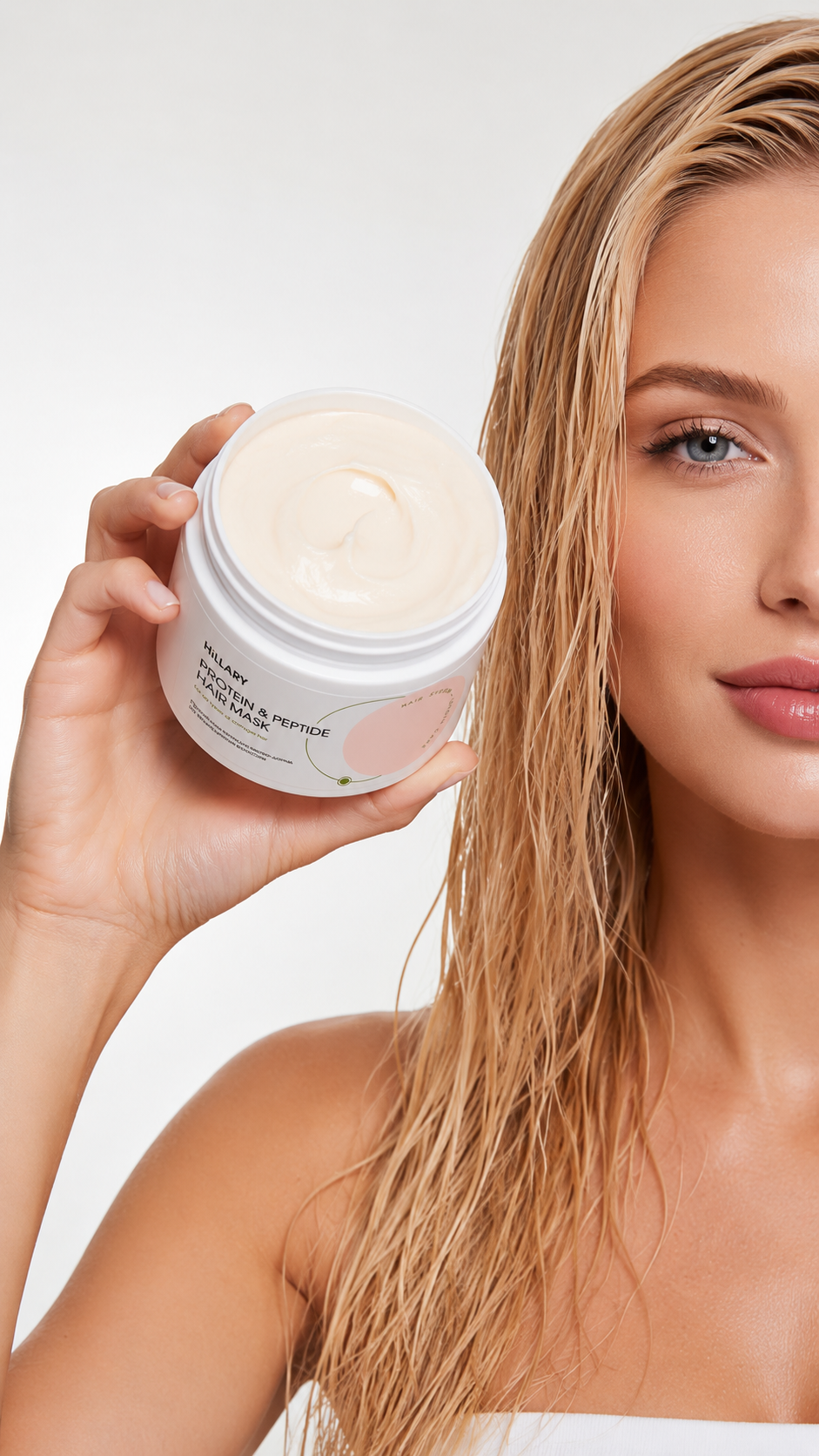 A hair peptide is a short chain of amino acids modeled after natural proteins. It works with the mechanical properties of the hair shaft: hair elasticity and resistance to breakage.
One example is Sr-Spider Polypeptide-1, a biomimetic peptide inspired by the structure of spider silk protein. Spider silk combines strength with stretchability: it stretches without tearing. This is exactly the combination damaged hair lacks – it is either stiff or brittle.
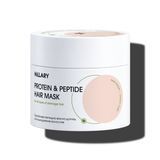
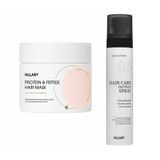
The Protein & Peptide Hair Mask is formulated according to the principle of “proteins together with hydration” to avoid protein overload.
The formula contains:
- Three proteins of different molecular weights – hydrolyzed rice protein, hydrolyzed hemp protein, hydrolyzed moringa seed extract
- Sr-Spider Polypeptide-1 – a peptide that helps improve hair elasticity and reduce breakage
- Gluconamido Amodimethicone – a new-generation conditioning ingredient that deposits specifically on damaged areas without weighing down the lengths
- Hydration complex – glycerin, maltooligosyl glucoside, hydrogenated starch hydrolysate
- Vitamin E – antioxidant protection
How to use: apply to damp hair along the lengths, leave for 5–10 minutes, then rinse thoroughly.
Questions and answers
What is the difference between hair hydration and nourishment? Hair hydration works with water – it helps retain moisture inside the hair shaft. Hair nourishment works with lipids – it restores fats and shine. These are different tasks requiring different ingredients.
How can you determine hair porosity at home? The most reliable signs are how quickly the hair absorbs water and how quickly it dries. The glass-of-water test is unreliable: the result depends on surface tension and product residue.
How long should you leave a hair mask on? 5–10 minutes. Leaving it on longer does not provide additional benefits.
How should you apply a hair mask correctly? Apply it to damp hair along the lengths, keeping it away from the roots. Do not apply it to the roots.
Which is better – a keratin or protein mask? Keratin provides a faster visual effect but is more likely to cause stiffness. A combination of proteins of different sizes with a peptide works more gently and consistently with regular use.
What is protein overload? A condition in which there is too much protein and not enough hydration: the hair becomes stiff and brittle despite regular care.
Will a mask help if your hair isn’t growing? If the cause is breakage, yes – it can help you retain your length. If the hair is falling out from the roots, you need scalp-focused products.