You wash your hair, but instead of feeling fresh, you end up with rough, stiff hair: it tangles, gets frizzy, and feels like straw to the touch. So naturally, you may wonder: why is your hair dry after shampooing if shampoo is supposed to make it better?
The reason is that shampoo removes not only dirt but also some of the natural lipids from the hair length, while the hair shaft swells in water and then dries with a raised cuticle. Three things are most often responsible for this: applying shampoo along the entire length, hard or excessively hot water, and skipping conditioner. Most of these issues can be corrected by changing your washing technique and using care products before shampooing.
Below, we’ll explain exactly what happens to your hair during washing, how to identify the cause in your case, and what you can change starting with your next wash.
What Happens to Your Hair During Washing
The outer layer of the hair shaft is the cuticle — a layer of tiny scales arranged like roof shingles. When these scales lie tightly against one another, the hair feels smooth, looks shiny, and is easy to comb. When they lift, the surface becomes rough: individual hairs catch on each other, tangle, and look dull. 
During washing, the cuticle is affected by three factors at once:
- Surfactants in shampoo. They dissolve sebum, dust, and styling-product residue, but they cannot distinguish between “dirt” and the “protective layer”: along with impurities, some of the lipids that keep the hair length soft are also removed.
- Water. The hair shaft absorbs water and swells slightly, then contracts as it dries. When this happens several times a week, the cuticle gradually loses its compactness.
- Mechanical stress. Lathering, rubbing, and brushing wet hair all add extra stress to a surface that is at its most vulnerable during washing.
The root area receives fresh sebum every day, so you rarely notice dryness there. The lengths and ends, however, “live” for months and years — and every wash has a stronger effect on them.
Why Is Your Hair Dry and Rough After Shampooing? 7 Reasons
- You apply shampoo to the entire length. This is the most common mistake. Shampoo is designed for the scalp — that’s where sebum and impurities accumulate. The lengths only need the foam that runs down them during rinsing. When shampoo is rubbed into the ends, they lose the most lipids.
- Hard water. Water with a high content of calcium and magnesium salts makes shampoo lather less effectively and rinse out less easily. Mineral residue can build up on the hair, making it feel rough and look dull. If limescale quickly appears in your kettle, there is a good chance your water is contributing to the problem.
- Water that is too hot. Hot water dissolves lipids more effectively — both from the hair and the scalp. Warm water cleans just as well, while the final rinse is better done with cooler water.
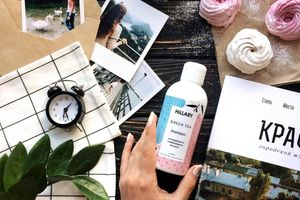
- Your shampoo doesn’t match your needs.A product with an intensive cleansing formula may be too harsh for dry lengths. For regular washing, it is better to choose shampoos with gentle cleansing agents based on amino acids and glucosides — such as HiLLARY Polynucleotide Shampoo (Sodium Cocoyl Glutamate, Coco-Glucoside), enriched with panthenol and prebiotics for the scalp.
- Bleaching, coloring, and porosity.Chemical treatments make the cuticle more open, making the hair porous: it absorbs water quickly but loses it just as quickly. Naturally porous hair can also be curly or wavy — after washing, it is worth choosing a conditioner with emollients, such as HiLLARY Lipid Conditioner with shea butter and moringa extract.
- You skip conditioner.Shampoo cleanses but does not make the hair smooth. Conditioners and masks perform this function: their ingredients bind to the surface of the hair shaft and help the cuticle scales lie closer together.
- Towel drying and brushing wet hair. Wet hair is at its least resistant to mechanical stress. Vigorous rubbing with a towel, wrapping it tightly into a “turban,” and brushing immediately after washing all contribute to roughness and breakage.
How to Identify Your Cause
|
What you notice |
Likely cause |
What to change |
|
The ends are drier than the middle of the length |
Shampoo applied to the entire length |
Apply shampoo only to the scalp |
|
Hair feels rough and dull and is difficult to rinse clean |
Hard water |
Shower filter, acidic rinse |
|
Dryness increased after bleaching |
Porosity |
Care before and after washing, gentle shampoo |
|
Hair tangles immediately after washing |
Raised cuticle, insufficient conditioning |
Pre-shampoo + conditioner |
|
Oily roots, dry lengths |
Shampoo too harsh for the lengths |
Separate care for the lengths |
|
Hair gets “puffy” after drying |
Moisture loss, friction |
Blot with a towel, use heat protection |
It is common for several factors to occur at the same time — in that case, a comprehensive approach works best.
Pre-Shampoo: Hair Care Before Washing
Conditioners, masks, and oils are usually applied after shampooing, when the hair has already been cleansed. A pre-shampoo works from the other direction: it is applied before washing to prepare the lengths for contact with shampoo.
The idea is not new. Long before dedicated products appeared, people applied oils to their hair before washing — you have probably seen advice about “oil treatments.” Cosmetic research has described how coconut oil applied before washing helped reduce protein loss from hair (Rele & Mohile, Journal of Cosmetic Science, 2003). The downside of oil treatments is that they can be difficult to wash out, often requiring two shampoos.
A cream-based pre-shampoo for hair combines the benefits of oil with conditioning ingredients and is easier to rinse out.
What’s in the HiLLARY Pre-Shampoo
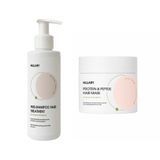
HiLLARY Pre-Shampoo Care for All Hair Types is part of the “Scalp Microbiome & Damaged Hair Care” line. Lightweight cream texture, 200 ml.
|
Ingredient (INCI) |
What it does |
|
Coconut Oil |
Softens the lengths and helps maintain their lipid layer before cleansing |
|
Hydrolyzed Rice Protein |
Forms a lightweight film on the hair surface and promotes smoothness and softness |
|
Hydrolyzed Hemp Seed Extract |
Conditions the hair and makes it feel more pleasant to the touch |
|
Hydrolyzed Moringa Oleifera Seed Extract |
Hydrolyzed Moringa Oleifera Seed Extract | Helps maintain a well-groomed appearance and supports protection of the surface from the deposition of pollution particles |
|
Conditioning Complex (Behentrimonium Chloride, Behentrimonium Methosulfate, Cetrimonium Chloride) |
Makes combing easier, reduces static electricity, and makes the hair more manageable |
|
Glycerin |
Helps retain moisture |
|
Dimethicone, Dimethiconol |
Smooth the hair surface and reduce friction between individual hairs |
The result is softer hair that is easier to comb and less prone to tangling after washing.
How to Use Pre-Shampoo
- Slightly dampen your hair – it should be damp, not soaking wet; squeeze out excess water with your hands
- Apply the product to the lengths and ends, from the middle of the length down to the ends. Do not apply it to the scalp
- Leave it on for 5–10 minutes – there is no need to leave it on longer
- Rinse thoroughly with warm water
- Wash your hair with shampoo– apply shampoo only to the scalp
- If needed, apply conditioner or a mask – for very dry, bleached, or curly hair, it is worth keeping this step in your routine
Before the first use, perform a patch test on a small area of skin, as individual sensitivity to the ingredients is possible. Avoid contact with the eyes.
How to Combine Pre-Shampoo With Other Products
Pre-shampoo is only the first step. The best results come from a consistent routine: pre-shampoo takes care of the lengths before washing, shampoo takes care of the scalp, and conditioner or a mask provides smoothness after cleansing. In the HiLLARY line, the pre-shampoo is already included in ready-made care systems:
|
Your situation |
System |
What’s included |
|
You want complete care from scalp to ends |
pre-shampoo, polynucleotide shampoo, lipid conditioner |
|
|
Dry, brittle, damaged lengths |
pre-shampoo, protein peptide mask |
|
|
Oily roots, dry lengths |
pre-shampoo, salicylic shampoo, salicylic conditioner |
|
|
Weak, brittle hair that needs maximum care |
pre-shampoo, shampoo, conditioner, protein peptide mask |
Who Can Benefit Most From Pre-Shampoo
- Dry and dehydrated hair, that becomes rough after every wash
- Colored and bleached hair– especially porous hair that loses moisture quickly
- Curly and wavy hair proneto tangling and frizz
- Long hair where the endsare significantly drier than the roots
- Combination hair – oily roots and dry lengths: pre-shampoo cares for the lengths without getting onto the scalp
Not sure what your hair type is? Start with the article “How to Determine Your Hair Type.” And if it is difficult to understand what your hair is lacking — moisture or lipids — read about how to tell the difference between hair hydration and nourishment.
5 More Habits That Can Help Prevent Dryness After Washing
- Use warm, not hot, water. Make the final rinse cool
- Shampoo only the scalp. The foam cleanses the lengths
- Blot rather than rub. A cotton T-shirt or microfiber towel is gentler than a terry towel
- Brush your hair when it is slightly dry – starting at the ends and gradually working your way upward
- Protect the lengths from sun, wind, and chlorinated water.Learn more about the effects of urban pollution in the article“Anti-Pollution Hair Care for Life in a Megacity.”
For more about everyday mistakes, see the article “8 Harmful Habits for Your Hair.”
Questions & Answers
Why is my hair dry and rough after shampooing? Shampoo partially removes natural lipids from the hair lengths, while water and friction raise the cuticle. The most common causes are applying shampoo to the entire length, hard or hot water, and skipping conditioner.
Can I apply pre-shampoo to my scalp? No. The product is designed for the lengths and ends. Shampoo cleanses the scalp, so apply pre-shampoo from the middle of the length to the ends.
Does pre-shampoo replace conditioner? No, they are different steps. Pre-shampoo prepares the lengths for washing, while conditioner cares for the hair after cleansing. For normal hair, pre-shampoo alone may be enough; for dry, bleached, or curly hair, it is better to use both products.
Does pre-shampoo weigh hair down? When used correctly, no. The product is applied only to the lengths, left on for 5–10 minutes, and rinsed out before shampooing. If your hair is fine, start with a smaller amount.
How often should I use pre-shampoo? You can use it before every wash. If your hair is not very dry, 1–2 times a week may be enough.
Is pre-shampoo suitable if I have an oily scalp?Yes, if your lengths are dry. The product is not applied to the roots, so it cares only for the lengths. For this combination, there is a scalp oiliness reduction system: pre-shampoo for the lengths and salicylic shampoo for the roots.
How is pre-shampoo different from oiling your hair before washing?Oil is usually left on for longer and can be more difficult to rinse out — often requiring two washes. A cream-based pre-shampoo works in 5–10 minutes, rinses out easily, and contains conditioning ingredients in addition to oil. Learn more about oils in the articles “TOP 8 Hair Oils” and “The Benefits of Coconut Oil.”